
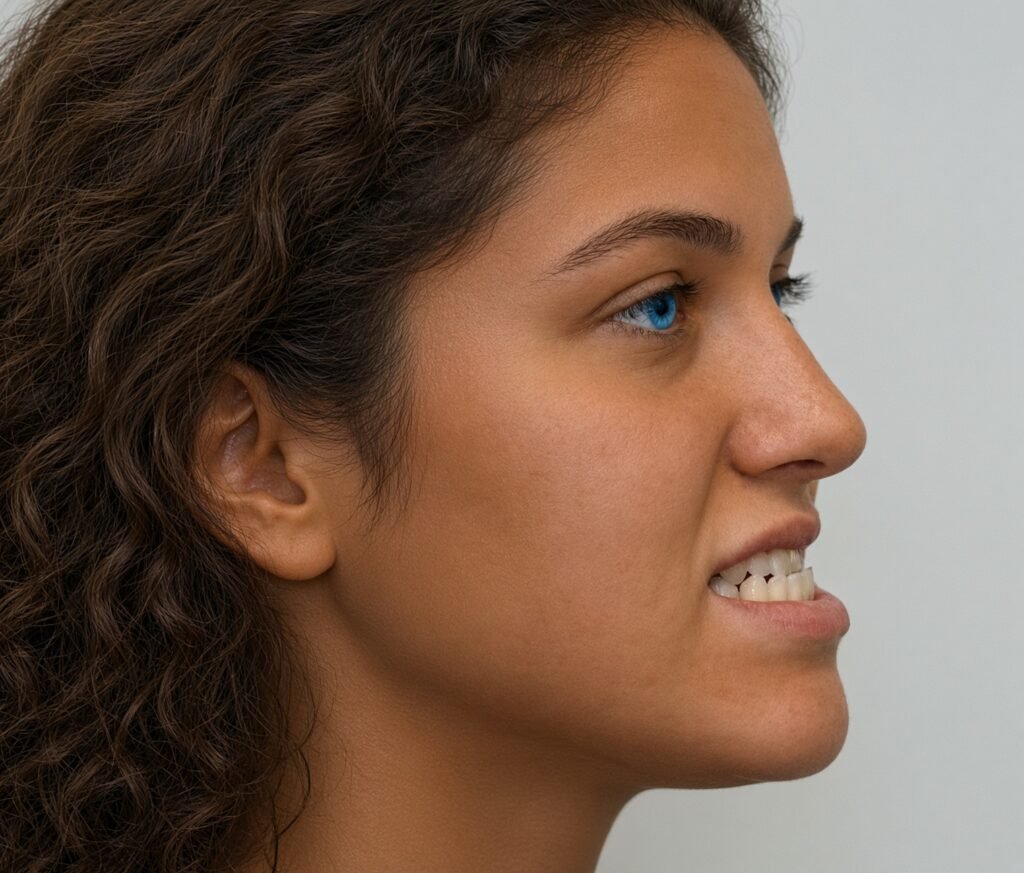
By Dr. Manu Sharma, DMD, board certified orthodontist | Updated November 2026
An underbite is one of the bite problems parents spot most easily. When a child bites down, the lower front teeth sit in front of the upper front teeth instead of behind them. In profile, the chin may look strong and the middle of the face a little flat.
It is also the bite problem where timing matters most. An underbite caught at age 7 or 8 often has options that disappear by the early teens, and an adult underbite raises a question a child's rarely does: can braces handle this, or does the jaw itself need to move?
This guide explains what causes an underbite, how orthodontists tell the types apart, what the best current research says about early treatment, and how the options change from childhood through adulthood. I will be clear about where the evidence is strong and where it is still thin.
Key Takeaways
- An underbite (Class III bite) can come from the teeth, the jaws, a forward jaw shift, or a combination, and the type decides the treatment.
- Underbites run in families; a parent or grandparent with one is a reason to have your child checked by age 7.
- A 2024 Cochrane review of 29 trials and 1,169 children found early treatment clearly improves the bite in the short term.
- Facemask gains fade over several years, but treated children were less likely to be judged as needing jaw surgery later.
- For adults with a skeletal underbite, the choice is usually camouflage with braces or aligners versus braces combined with jaw surgery.
What Is an Underbite?
In a healthy bite, the upper teeth close slightly in front of and over the lower teeth, like a lid on a box. In an underbite, that relationship is reversed at the front: the lower incisors close in front of the upper incisors, or the front teeth meet edge to edge.
Orthodontists call this a Class III bite. You may also see it described as an anterior crossbite (when it involves only the front teeth) or prognathism (when the lower jaw itself is large or forward). These terms overlap, but they are not the same thing, and the difference matters for treatment.
How Common Are Underbites?
Underbites are less common than overbites, but far from rare. A review in Orthodontic Update reports that the prevalence of Class III ranges from close to zero to nearly 40 percent depending on the population studied, with a global average of roughly 6 to 11 percent. It is more common in East Asian and Middle Eastern populations and less common in European, African, and South Asian populations. In a community as diverse as the Tri City area, underbites are a regular part of everyday orthodontic practice.
What Causes an Underbite?
Genetics and family history
Underbites tend to run in families. A 2013 study in The Angle Orthodontist traced 100 patients with a prominent lower jaw through 3,777 relatives across at least three generations. It found clear family clustering, with similar correlations between siblings and between parents and children. Interestingly, the pattern did not fit a single "underbite gene." It pointed instead to many genes with small effects, combined with environmental factors.
In practical terms: if a parent, grandparent, or sibling has an underbite or had jaw surgery to correct one, mention it at your child's first visit. It does not mean your child will develop one, but it changes how closely we watch growth.
Jaw growth
Most childhood underbites involve one or both of these:
- An upper jaw that is underdeveloped or set back (maxillary deficiency). This is especially common in children.
- A lower jaw that is large or positioned forward (mandibular prognathism).
Tooth position
Sometimes the jaws are fine and the problem is the teeth: upper front teeth tipped backward, lower front teeth tipped forward, or a single permanent tooth erupting behind its neighbor.
Habits and function
Some children slide their lower jaw forward when they close because a tooth contact gets in the way. Over time, that forward posture becomes their normal bite. Habits such as resting the tongue low and forward have also been discussed as contributors, though the evidence for most habits is weaker than for genetics and jaw growth.
Less common causes
Facial injuries that affect jaw growth, cleft lip and palate, and certain craniofacial conditions can also produce an underbite. These are uncommon and are usually managed by a team that includes surgeons and other specialists.
The Three Main Types of Underbite
Telling these apart is the core of diagnosis, because they look similar in the mirror but call for different treatment.
| Type | What is going on | Typical treatment |
|---|---|---|
| Dental | Jaws are in reasonable balance; front teeth are tipped or positioned wrongly | Braces or aligners at almost any age |
| Functional (pseudo Class III) | The child shifts the lower jaw forward to avoid a tooth contact; front teeth can often meet edge to edge | Remove the interference with a simple appliance or limited braces, often early |
| Skeletal | The upper jaw is small or back, the lower jaw is large or forward, or both | Growth guidance in children; camouflage or jaw surgery in adults |
Many real cases are a combination: a skeletal imbalance with teeth that have already tipped to partly hide it. That built in compensation can make an underbite look milder than it is, which is one reason a proper X ray based diagnosis matters.
How we tell them apart. We check whether the front teeth can meet edge to edge when the jaw is guided back, which points toward a functional shift. We look at the profile, the width of the upper jaw, and how the back teeth meet. A side profile X ray, analyzed as I describe in our article on cephalometric analysis, measures whether the upper jaw is back, the lower jaw is forward, or both, and how much the teeth have compensated. In growing children, the same X ray shows skeletal maturity, which helps with timing.
Signs and Symptoms to Watch For
- Lower front teeth in front of the upper front teeth when biting down.
- Front teeth that meet edge to edge.
- A prominent chin or a flatter middle face in profile.
- Difficulty biting into foods like sandwiches or apples with the front teeth.
- Uneven wear or chipping on the front teeth.
- The jaw sliding forward as the teeth close together.
- Some speech sounds affected, such as "s" and "th," in more pronounced cases.
Why Timing Matters So Much
The upper jaw responds best when children are young. Before and around the start of puberty, the bones and sutures (growth seams) around the upper jaw respond much better to orthopedic forces that encourage it forward. One of those seams, the midpalatal suture in the roof of the mouth, gradually matures through the teens, which also makes expansion harder with age.
Underbite growth often continues longer. The Orthodontic Update review notes that pubertal growth in Class III patients appears to start later and go on longer than in their Class I peers. Lower jaw growth can continue well into the late teens. That is why an underbite that looks fully corrected at age 10 still needs periodic checks through adolescence, and why surgery, when needed, is usually planned after growth has finished.
Front tooth crossbites cause wear. When upper front teeth are locked behind the lower teeth, enamel can wear and the gum over the lower incisors can thin. Fixing this early protects the teeth.
All of this is why the American Association of Orthodontists recommends a first orthodontic evaluation by about age 7, and why underbites are one of the most common reasons for treating a younger child. Our page on early orthodontic evaluation explains what that visit involves.
What the Research Says About Early Treatment
The 2024 Cochrane review
The most complete summary of the evidence is the 2024 Cochrane systematic review Orthodontic treatment for prominent lower front teeth (Class III malocclusion) in children, by Owens, Watkinson, Harrison, Turner, and Worthington. It pooled 29 randomized controlled trials involving 1,169 children aged 5 to 13.
| Finding | Result | Certainty of evidence |
|---|---|---|
| Nonsurgical treatment vs. no treatment, right after treatment | Overjet improved by about 5 mm; jaw relationship (ANB) improved by about 3 degrees | Moderate |
| Facemask results over time (one trial) | Gains shrank by 3 years and were no longer detectable at 6 years | Low |
| Need for jaw surgery as adults (same trial) | Untreated children were about 3 times more likely to be judged as needing surgery | Low |
| Facemask vs. other nonsurgical appliances | No single appliance clearly better | Very low |
| Adding expansion or bone anchors to a facemask | No clear extra benefit for jaw relationship | Low |
The authors concluded that early treatment improves the bite and jaw relationship in the short term with moderate certainty, and that although facemask benefits fade over time, treated children were less likely to be judged as needing jaw surgery. They also said their confidence in the long term findings is low and called for more research.
The trial behind the long term results
The long term data in that review comes largely from a multicenter randomized trial led by Mandall and colleagues in the United Kingdom, published in the Journal of Orthodontics in 2016. Children aged 7 to 9 were randomly assigned to early facemask treatment or no early treatment and followed for six years. At six years, 36 percent of the facemask group were judged to need jaw surgery, compared with 66 percent of the untreated group, and 68 percent of the treated children still had a positive overjet (upper teeth correctly in front).
What this means for families. Early treatment is not a guarantee. Some children will still need surgery after growth finishes, because the genetic growth pattern reasserts itself. But for many children, early treatment improves function and appearance during childhood and meaningfully lowers the odds of surgery later. That is a worthwhile trade, provided families go in with realistic expectations.
Does your child's bite look reversed?
An early evaluation shows whether the underbite comes from the teeth, a jaw shift, or the jaws themselves, and whether now is the right time to act.
Treatment Options by Age
Young children (about ages 6 to 10)
- Correcting a functional shift. When the jaw slides forward to avoid a tooth contact, removing that interference with a simple appliance or a few braces can resolve the underbite, sometimes quickly.
- Palatal expansion. Many Class III children also have a narrow upper jaw. A palatal expander widens it and corrects any side crossbite. Our article on crossbites in children explains how expansion works.
- Protraction facemask (reverse pull headgear). A frame that rests on the forehead and chin, connected by elastics to an appliance on the upper teeth, gently encourages the upper jaw forward. It is worn mainly in the evening and overnight, typically for many months, and consistent wear is what makes it work. Most protocols aim for a slight overcorrection to allow for later growth.
- Other appliances. Removable functional appliances and chin cups are sometimes used. The Cochrane review found no clear evidence that any one nonsurgical appliance outperforms the others, so the choice depends on the type of underbite, the child's age, and what the family can manage day to day.
Preteens and teens
- Bone anchored approaches. Newer techniques attach elastics to small plates or anchors placed in the jaw bones, applying force directly to bone rather than teeth. Early results are promising, but the Cochrane review found only one small trial and no long term follow up, so this is still an evolving option.
- Growth monitoring. Because Class III growth can continue late, many teens are checked every 6 to 12 months to see how the lower jaw develops before final decisions are made.
- Braces or aligners with elastics. For dental and milder skeletal cases, braces or aligners combined with Class III elastics (rubber bands) can align the teeth and refine the bite.
Adults
Adults have finished growing, so orthopedic approaches like facemasks no longer apply. The decision usually comes down to two paths.
- Orthodontic camouflage. Braces or aligners position the teeth to create a functional bite while the jaws stay where they are. This works well for dental and mild skeletal underbites when the person is comfortable with their profile. The limit is biological: teeth can only be tipped so far within the bone before roots and gums are put at risk, and camouflage does not change the profile much.
- Orthodontics combined with jaw surgery. For more significant skeletal underbites, an oral and maxillofacial surgeon repositions the upper jaw, the lower jaw, or both. Orthodontic treatment before surgery aligns the teeth for their new jaw position, and a shorter phase after surgery fine tunes the bite. The American Association of Oral and Maxillofacial Surgeons lists a protruding jaw, difficulty chewing or biting, excessive tooth wear, and facial imbalance among the reasons corrective jaw surgery is considered, and describes the process as a long term partnership between the surgeon and the orthodontist.
Some adults with an underbite also have a narrow upper jaw. In those cases MARPE, which anchors the expander to the palate with small temporary screws, can widen the upper jaw without surgery as part of the overall plan. Our page on orthodontic treatment for adults covers broader options.
Camouflage or Surgery? How the Decision Is Made
For adults, this is the most important conversation. In my experience, it comes down to four questions:
- How large is the skeletal discrepancy? Small differences can often be camouflaged. Large ones usually cannot be corrected well with teeth alone.
- How much have the teeth already compensated? If the lower front teeth are already tipped far back and the upper ones far forward, there may be little room left to camouflage safely.
- What bothers you most? If chewing, wear, or the bite is the main concern and you like your profile, camouflage may be ideal. If your facial profile is the main concern, only surgery meaningfully changes it.
- What are your health and life circumstances? Surgery involves anesthesia, a hospital stay, and recovery time. That is a personal decision, and a good orthodontist lays out both paths honestly.
When both paths are reasonable, I say so. When camouflage would compromise the result or the health of the teeth, I explain why surgery is the honest recommendation.
Does an Underbite Get Worse With Age?
In children and teens, it can. Because Class III growth often continues late, an underbite may become more pronounced through puberty, especially when the lower jaw is the main driver.
In adults, the jaws are generally stable, but the bite can still change slowly. Teeth wear, shift, and sometimes are lost, and those changes can make an existing underbite feel worse or affect chewing.
Living With a Facemask: Tips for Parents
- Build it into the evening routine. Homework, reading, and screen time can all happen with the facemask on.
- Expect an adjustment period. The first week or two is the hardest; it gets easier quickly.
- Check the skin where the pads rest, and let us know if redness lasts.
- Make progress visible. Children stay more motivated when they can see change, so we are glad to show comparisons at visits.
How an Underbite Compares With Other Bite Problems
| Bite problem | What you see | Common causes | Typical treatment |
|---|---|---|---|
| Underbite | Lower front teeth in front of upper | Jaw growth pattern, genetics, tooth position, forward jaw shift | Early growth guidance, braces or aligners, or surgery in adults |
| Overbite or overjet | Upper front teeth far over or ahead of lower | Lower jaw set back, tooth position, habits | Braces or aligners, growth guidance in children |
| Crossbite | Some upper teeth bite inside lower teeth | Narrow upper jaw, tooth position | Expanders, braces or aligners |
| Open bite | Front teeth do not meet when back teeth close | Habits such as thumb sucking, jaw growth pattern | Habit correction, braces or aligners, sometimes surgery |
A word about airway claims. You may read that underbites cause sleep apnea or breathing problems. Jaw shape and airway are related in complex ways, but the American Association of Orthodontists' 2026 guidance states that no specific facial pattern reliably identifies sleep disordered breathing, and diagnosis belongs to a physician. If your child snores or mouth breathes, our article on mouth breathing and snoring in children explains the right next steps.
What an Underbite Evaluation Includes
At our office, an underbite evaluation is part of the free consultation. It typically includes:
- A conversation about your concerns and your family history of underbites or jaw surgery.
- An exam of the bite, jaw movement, profile, and upper jaw width, including whether the front teeth can meet edge to edge.
- Diagnostic records: photographs, a 3D scan, a panoramic X ray, and a side profile X ray. When more detail is needed for complex or surgical cases, a 3D CBCT scan may be recommended.
- A clear explanation of whether the underbite is dental, functional, skeletal, or combined, and, for children, where they are in their growth.
- Your options, including when watching and waiting is the better choice, and a written estimate.
You can read more about what happens at your first visit, and our guide to what braces cost explains how insurance and payment plans work.
Frequently Asked Questions
Can an underbite fix itself?
A true skeletal underbite does not correct itself, and it can worsen with growth. Some mild front tooth crossbites in young children improve as permanent teeth come in, and functional shifts can resolve once the interfering contact is removed, but that should be confirmed by an orthodontist rather than assumed.
What is the best age to treat an underbite?
Many orthopedic treatments, such as facemasks, work best between about ages 7 and 10, while the upper jaw is most responsive. Because every case differs, an evaluation by about age 7 is the best way to decide on timing.
Is jaw surgery always needed for an underbite?
No. Dental and functional underbites are usually corrected with braces, aligners, or simple appliances, and early treatment lowers the chance of surgery for many children with skeletal underbites. Surgery is generally reserved for significant skeletal underbites in adults whose growth is complete.
Can braces alone fix an underbite?
For dental and mild skeletal underbites, often yes, using braces with Class III elastics. For larger skeletal underbites in adults, braces alone can only tip the teeth, which may not give a stable or attractive result.
Can Invisalign fix an underbite?
Mild, tooth related underbites can often be treated with aligners and elastics. Skeletal underbites usually need growth guidance in children or braces with surgery in adults. Our comparison of Invisalign and braces explains the trade offs.
Is facemask treatment uncomfortable for children?
Most children adjust within a week or two. It is worn mainly in the evening and overnight, so it rarely affects school. Some pressure on the teeth and mild skin irritation where the pads rest are the most common complaints.
My child's underbite runs in the family. What should we do?
Schedule an evaluation by age 7, mention the family history, and plan on periodic growth checks. Family history does not decide the outcome, but it helps us time treatment and watch for changes.
Will my child's underbite come back after treatment?
It can, because Class III growth may continue into the late teens. Even after successful early treatment, we monitor growth, and some children need further treatment later. Retainers also help hold the result. See our article on retainers after braces.
Does an underbite cause jaw joint problems?
Most people with underbites have no jaw joint symptoms, and the research linking bite type to TMJ problems is mixed. If you have jaw pain, clicking, or limited opening, our page on TMJ and TMD explains how those problems are evaluated.
Get Clear Answers About Your Bite
Underbites reward early attention and honest planning. Whether you are a parent in Newark or Fremont noticing your child's bite, or an adult wondering whether surgery is truly necessary, a board certified orthodontist can help you understand every reasonable option. Parents can also read our guide to children and braces.
Book a free consultation
We will explain whether your underbite comes from the teeth or the jaws, and outline every reasonable option, surgical and nonsurgical, with a written estimate.
This article is general educational information and is not a substitute for an in person evaluation by a licensed orthodontist.
References
- Owens D, Watkinson S, Harrison JE, Turner S, Worthington HV. Orthodontic treatment for prominent lower front teeth (Class III malocclusion) in children. Cochrane Database of Systematic Reviews. 2024;4:CD003451. Abstract summary via PubMed record.
- Mandall N, Cousley R, DiBiase A, et al. Early class III protraction facemask treatment reduces the need for orthognathic surgery: a multi centre, two arm parallel randomized, controlled trial. Journal of Orthodontics. 2016.
- Woon SC, Thiruvenkatachari B. Early orthodontic treatment for Class III malocclusion: a systematic review and meta-analysis. AJO DO. 2017;151:28 to 52. Summarized in Evidence Based Dentistry.
- Limitations of orthodontic treatment: Class III camouflage. Orthodontic Update.
- Ko JM, Suh YJ, et al. Segregation analysis of mandibular prognathism in Korean orthognathic surgery patients and their families. The Angle Orthodontist. 2013;83(6).
- de Almeida MR, et al. Early treatment of Class III malocclusion: 10 year clinical follow up. Journal of Applied Oral Science. 2011;19(4):431 to 439.
- American Association of Oral and Maxillofacial Surgeons. Corrective jaw surgery.
- Sleep disordered breathing and orthodontics: an American Association of Orthodontists white paper update. AJO DO. 2026;169(4):419 to 427. Summarized in JCO Editor's Corner, July 2026.