
By Dr. Manu Sharma, DMD, board certified orthodontist | October 2026
Parents often mention it almost in passing at the end of a visit: "She snores like her dad," or "He always sleeps with his mouth open." Sometimes it is nothing. Sometimes it is a sign of a breathing problem during sleep that deserves a closer look.
Airway health has become a hot topic online, and some of what you will read promises more than the evidence supports. As an orthodontist, I want to give you a balanced picture: what signs to watch for, who diagnoses sleep problems, what orthodontic treatment can and cannot do, and how the pieces fit together.
Key Takeaways
- Habitual snoring affects roughly 10 to 27 percent of children; obstructive sleep apnea affects about 1 to 5 percent.
- Sleep apnea is diagnosed by a physician with a sleep study, not from X rays or a dental exam.
- Adenotonsillectomy is the first line treatment for most children with sleep apnea.
- Palatal expansion can help selected children who also have a narrow upper jaw or crossbite.
- The AAO's 2026 guidance: orthodontists screen and refer, and treat when there is a genuine orthodontic need.
Snoring, Mouth Breathing, and Sleep Apnea: What Is the Difference?
These terms overlap but are not the same:
- Snoring is the sound of air moving past relaxed tissues in a partly narrowed airway. Occasional snoring during a cold is common and usually harmless.
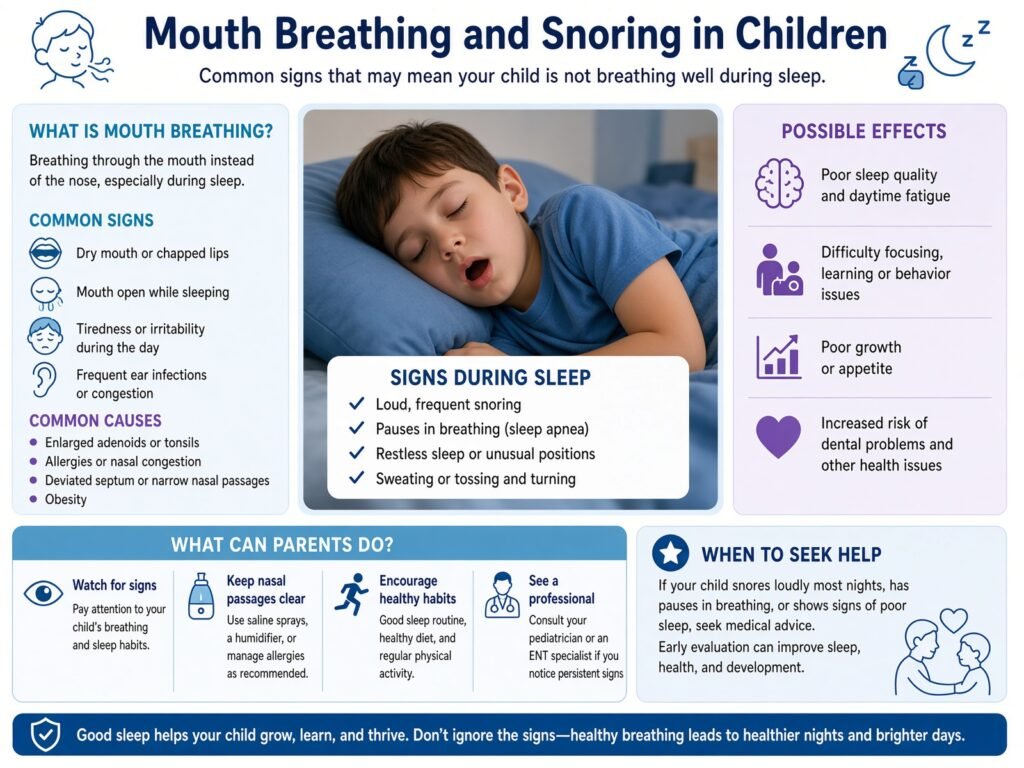
- Mouth breathing often happens when the nose is blocked, for example by allergies, enlarged adenoids, or a deviated septum. Over time it can become a habit.
- Obstructive sleep apnea (OSA) occurs when the airway repeatedly narrows or closes during sleep, interrupting breathing and sleep quality.
- Sleep disordered breathing is the broad term covering the whole range, from simple snoring to OSA.
A review in American Family Physician reports that habitual snoring occurs in roughly 10 to 27 percent of children, while obstructive sleep apnea affects about 1 to 5 percent, peaking between ages 2 and 8. Snoring regularly is a reason to bring it up with your pediatrician, because it is strongly associated with OSA.
Warning Signs Worth Mentioning to Your Pediatrician
The same review lists nighttime and daytime signs that can point to sleep disordered breathing:
At night - Loud, regular snoring, three or more nights a week - Pauses in breathing, gasping, or choking sounds - Restless sleep or frequent waking - Bedwetting after it had stopped - Sleeping with the mouth open
During the day - Daytime sleepiness, or, in many children, hyperactivity instead - Trouble paying attention or declining school performance - Irritability or behavior problems - Morning headaches - Constant mouth breathing while awake
None of these alone confirms a problem, but a combination deserves medical attention.
Who Diagnoses Sleep Apnea?
This point matters, so I will be direct: obstructive sleep apnea is a medical diagnosis made by a physician, usually with an overnight sleep study (polysomnography). The American Academy of Pediatrics recommends that pediatricians ask about snoring at routine visits and refer children with symptoms for further evaluation. American Family Physician notes that polysomnography is required to diagnose OSA in children, and that home testing and nap studies are not recommended for this purpose.
The American Association of Orthodontists made the same point in its 2019 white paper and its 2026 update: orthodontists play a valuable role in screening for sleep disordered breathing, but diagnosis and medical management belong to sleep physicians and other medical specialists. The update states plainly that airway dimensions on dental X rays or scans do not necessarily reflect how the airway functions during sleep, and that no specific facial or jaw shape reliably identifies children who have the condition.
So if anyone offers to diagnose sleep apnea from a dental X ray, or promises that an appliance will cure it, be cautious.
How Is Childhood Sleep Apnea Treated?
Adenotonsillectomy comes first for most children. Enlarged tonsils and adenoids are the most common cause of OSA in children. Removing them is the first line treatment recommended in pediatric guidelines. American Family Physician reports resolution in roughly 70 percent of children at a healthy weight, but fewer than 30 percent of children with obesity.
Other medical options include CPAP (a mask that keeps the airway open during sleep), weight management when relevant, and treating nasal allergies. Your pediatrician, an ear nose and throat specialist, or a sleep physician will guide these choices.
Where Orthodontic Treatment Fits
Orthodontics is part of the picture for some children, not all. Here is what the current evidence supports.
Palatal expansion for children with a narrow upper jaw
Many children who mouth breathe also have a narrow upper jaw and a high palate, sometimes with a crossbite. In these children, widening the upper jaw with a palatal expander is a legitimate orthodontic treatment in its own right, and it also widens the floor of the nose.
The American Thoracic Society's 2025 guideline on children whose OSA persists after adenotonsillectomy, summarized in American Family Physician, suggests rapid maxillary expansion for children from about age 6 or 7 until puberty who have persistent OSA and a posterior crossbite. The recommendation is conditional, based on very low quality, observational evidence, and it lists side effects such as temporary changes in speech and tongue movement.
What the evidence does not support
The AAO's 2026 update addressed several popular claims directly:
- Expansion or functional appliances as prevention. The update found no evidence that orthodontic appliances prevent sleep disordered breathing over a person's lifetime.
- Extractions causing sleep apnea. It found no evidence that routine orthodontic procedures, including extractions, increase the risk of developing sleep disordered breathing.
- "Bigger airway means better sleep." Simply increasing airway size does not necessarily translate into better breathing during sleep.
An older Cochrane review on oral appliances and functional orthopedic appliances for childhood sleep apnea reached a similar conclusion about the strength of the evidence: there was not enough to confirm their effectiveness as a treatment for OSA.
Our approach
In practice, this shapes our airway focused orthodontic care:
- We ask about sleep and breathing at every child's evaluation.
- When we see warning signs, we refer to your pediatrician or a sleep specialist for medical evaluation.
- When there is a genuine orthodontic reason to treat, such as a narrow upper jaw or crossbite, we coordinate that treatment with the child's physicians, and we are clear that any breathing improvement is a possible bonus, not a promise.
Our article on crossbites in children explains when expansion is indicated for the bite itself.
Concerned about your child's breathing or bite?
We screen every child for signs of sleep disordered breathing and will tell you clearly whether orthodontic treatment, a medical referral, or both make sense.
Habits and Simple Steps Parents Can Take
While you wait for an evaluation, a few things can help:
- Treat nasal congestion. Allergies are a common reason children breathe through their mouths. Talk with your pediatrician about managing them.
- Keep a short sleep log. Note snoring, pauses, restless sleep, and daytime behavior for a couple of weeks. A short video of your child sleeping can be very helpful to the doctor.
- Protect sleep routines. Consistent bedtimes and screens off before bed support good sleep for every child.
- Ask about tonsils and adenoids at your child's next checkup if snoring is regular.
Myths and Facts
| Myth | What the evidence says |
|---|---|
| Expanders cure sleep apnea. | Expansion may help selected children with a narrow jaw or crossbite, alongside medical care. It is not a cure on its own. |
| Taking out teeth for braces causes sleep apnea. | The AAO's 2026 review found no evidence linking routine extractions to sleep disordered breathing. |
| A dental X ray can diagnose sleep apnea. | Diagnosis requires a physician and usually an overnight sleep study. |
| Snoring in kids is always harmless. | Regular snoring is common but strongly associated with OSA and worth mentioning to a pediatrician. |
How We Screen for Breathing Concerns at an Orthodontic Visit
Screening is a short, structured part of every child's evaluation in our office. It typically includes:
- Questions for parents about snoring, pauses in breathing, restless sleep, bedwetting, daytime behavior, and attention.
- A look at the nose and mouth, including the size of the tonsils when visible, the shape and width of the palate, and whether the lips rest together comfortably.
- An assessment of the bite and jaws, such as crossbites, a narrow upper arch, or a long face pattern, which can travel together with mouth breathing.
- A review of medical history, including allergies, asthma, prior tonsil or adenoid surgery, and any previous sleep evaluations.
If anything raises concern, we share what we found with you and, with your permission, with your pediatrician. We may suggest an evaluation by an ear nose and throat specialist or a sleep physician. That referral does not delay orthodontic care when orthodontic care is needed; the two often proceed side by side.
What to Bring to Your Pediatrician
To make the most of a medical visit about snoring or mouth breathing, bring your sleep log, any short videos of your child sleeping, a list of daytime concerns from home and school, and a note of any allergies or medications. Mention a family history of sleep apnea if there is one. These details help the physician decide whether a sleep study or referral is the right next step.
Frequently Asked Questions
Is it normal for my child to snore?
Occasional snoring, especially with a cold, is common. Regular snoring several nights a week, particularly with pauses, gasping, or restless sleep, should be discussed with your pediatrician.
Can an orthodontist diagnose sleep apnea?
No. Orthodontists can screen for warning signs and refer, but sleep apnea is diagnosed by a physician, usually with an overnight sleep study.
Will a palatal expander help my child breathe better?
It may help some children, particularly those with a narrow upper jaw or crossbite, and guidelines suggest it for selected children with persistent sleep apnea after tonsil and adenoid surgery. It is not a guaranteed fix, and the decision should involve your child's physician.
Does mouth breathing change how the face grows?
Mouth breathing is often associated with a narrow upper jaw and a long face pattern, but the relationship is complex and research continues. The practical step is to identify and treat the cause of the mouth breathing with your pediatrician.
At what age should my child see an orthodontist?
The AAO recommends a first check by about age 7. Our early orthodontic evaluation page explains what that visit covers.
A Team Approach to Your Child's Health
The best outcomes for children with breathing concerns come from teamwork between parents, pediatricians, sleep specialists, ear nose and throat surgeons, and orthodontists. If you live in Newark, Fremont, Union City, or Milpitas, we would be glad to be part of your child's team.
Book a free early evaluation
We will check your child's bite and jaw development, screen for breathing concerns, and coordinate with your pediatrician when needed.
This article is general educational information and is not a substitute for an in person evaluation by a licensed orthodontist.
References
- Common sleep disorders in children. American Family Physician. 2022.
- Marcus CL, et al. Diagnosis and management of childhood obstructive sleep apnea syndrome. American Academy of Pediatrics clinical practice guideline. Pediatrics. 2012;130(3):576.
- Obstructive sleep apnea management in children despite adenotonsillectomy: guidelines from the American Thoracic Society. American Family Physician. 2025.
- Sleep disordered breathing and orthodontics: an American Association of Orthodontists white paper update. AJO DO. 2026;169(4):419 to 427. Summarized in JCO Editor's Corner, July 2026 and GDPUK.
- Kazmierski RH. Obstructive sleep apnea: what is an orthodontist's role? Progress in Orthodontics. 2024;25:21.
- Carvalho FR, et al. Oral appliances and functional orthopaedic appliances for obstructive sleep apnoea in children. Cochrane Database of Systematic Reviews. 2016.