
By Dr. Manu Sharma, DMD, board certified orthodontist | Updated November 2026
A crossbite is one of the most common reasons a young child is referred to an orthodontist, and one of the most commonly missed. It is often subtle, especially in the back teeth, and children almost never complain about it. Adults can have one for decades without knowing it has a name.
It is also a topic where online advice tends to be either alarmist or dismissive. Some sources say every crossbite needs immediate treatment; others say children grow out of them. The research shows both are partly true, depending on the type of crossbite and the child's age. This guide explains the types, what causes them, which ones are worth treating early, which ones can be watched, and what treatment looks like from early childhood through adulthood.
Key Takeaways
- A crossbite means some upper teeth bite inside the lower teeth instead of outside them, at the front, the back, or both.
- In a 2022 Swiss study, about three quarters of back tooth crossbites in baby teeth resolved on their own by the time permanent molars arrived.
- Crossbites that persist, cause the jaw to shift sideways, or trap a front tooth are the ones most worth treating early.
- A 2021 Cochrane review found expanders correct back tooth crossbites far better than waiting in children aged 7 to 11.
- Teens and adults can still be treated, often with MARPE or surgically assisted expansion when the palate has matured.
What Is a Crossbite?
In a healthy bite, the upper teeth sit slightly outside the lower teeth all the way around, like a lid on a box. In a crossbite, one or more upper teeth close on the inside of the lower teeth instead.
Crossbites are described in two ways: where they are and why they happen.
By location
- Posterior crossbite (back teeth). One or more upper back teeth sit inside the lower back teeth. It can affect one side (unilateral) or both sides (bilateral). This is the most common type.
- Anterior crossbite (front teeth). One or more upper front teeth sit behind the lower front teeth. It may involve a single tooth that came in behind its neighbors, or several teeth as part of a developing underbite. Our article on underbite treatment covers the skeletal version in detail.
By cause
| Type | What is going on | What it usually needs |
|---|---|---|
| Dental | Jaws are a normal size; one or more teeth came in tipped or out of position | Moving the individual teeth, often with a simple appliance or limited braces |
| Skeletal | The upper jaw is too narrow, or the jaws are mismatched in size or position | Widening the upper jaw, or growth guidance; in adults sometimes surgery |
| Functional | Teeth meet edge to edge, so the lower jaw slides sideways or forward to find a comfortable bite | Removing the cause of the slide, usually by expansion or moving a tooth |
Many real crossbites combine more than one of these. For example, a mildly narrow upper jaw often leads to a functional shift, and over time the teeth tip to compensate.
How Common Are Crossbites?
Posterior crossbite is one of the most frequent findings in children's bites. The 2021 Cochrane review on posterior crossbite treatment cites a prevalence of around 4 percent in European children and adolescents and about 17 percent in Americans. A 2022 study of Geneva schoolchildren found a posterior crossbite in about 10 percent of children while they still had baby teeth, and in about 6 percent once permanent molars had come in. Rates vary with population, age, and how crossbite is defined, which explains the wide range you will see quoted online.
What Causes a Crossbite?
A narrow upper jaw
Most back tooth crossbites start with an upper jaw that is narrower than the lower jaw. That can be inherited, or it can develop over time.
Pacifier and thumb sucking habits
Prolonged sucking habits are one of the best documented contributors. A 2018 systematic review in Progress in Orthodontics found that more than half of the included studies linked pacifier use to posterior crossbite, and that how long a child used a pacifier mattered more than how often. In one study it summarized, about 25 percent of children who used a pacifier past 36 months had a posterior crossbite, compared with about 16 percent of those who stopped earlier and about 6 percent of children who never used one. A 2024 randomized trial in the European Journal of Orthodontics found that children who used a pacifier for 12 months or longer were more likely to have a posterior crossbite at age 7.
The American Academy of Pediatric Dentistry encourages parents to end nonnutritive sucking habits by 36 months of age, and recommends checking how the back teeth meet before age three. The American Dental Association notes that most children stop thumb sucking between ages two and four, and that vigorous sucking is more likely to affect the teeth than passive resting.
Mouth breathing and enlarged tonsils or adenoids
When the nose is blocked, children breathe through the mouth and the tongue tends to rest low instead of against the roof of the mouth. This is associated with a narrower upper jaw, although the relationship is complex. If your child snores or breathes through the mouth most of the time, our article on mouth breathing and snoring in children explains when to involve your pediatrician.
Tooth eruption problems
Baby teeth that stay too long, permanent teeth that erupt in the wrong position, crowding, and missing teeth can all push a single tooth into crossbite. These are usually dental crossbites and are often simple to correct.
Jaw growth pattern and genetics
Front tooth crossbites involving several teeth are often an early sign of an underbite growth pattern, which tends to run in families.
Injury and other causes
Less commonly, an injury to a baby tooth or the jaw can change how teeth erupt or how the jaw grows.
Signs and Symptoms to Watch For
In children:
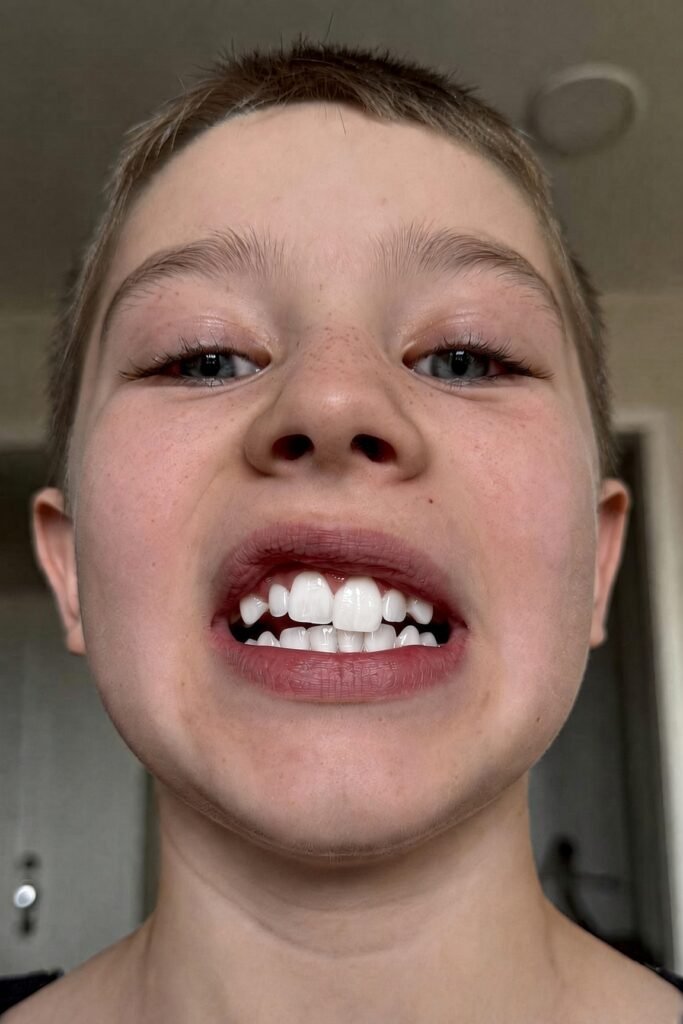
- When your child bites down and smiles, some upper back teeth disappear behind the lower ones.
- The chin looks off center with the teeth together, but centered when the mouth is open.
- An upper front tooth sits behind the lower front teeth.
- A lower front tooth with receding gum or uneven wear where the teeth strike.
- A narrow, high palate, often with mouth breathing.
In teens and adults:
- Frequent cheek or lip biting on one side.
- Uneven wear, chipping, or sensitivity on certain teeth.
- Gum recession on teeth that take the wrong forces.
- Chewing mostly on one side, or a jaw that feels like it has to find its bite.
- A smile that looks narrow or asymmetric.
These are clues, not a diagnosis. Telling the types apart takes an exam and usually X rays.
Do Crossbites Fix Themselves?
This is the most common question parents ask, and the honest answer is: sometimes, in very young children.
The best recent data comes from a 2022 study in the European Journal of Orthodontics that followed 693 Geneva schoolchildren through annual screenings. Of the 70 children who had a posterior crossbite in their baby teeth, 54 (about 77 percent) no longer had one once their first permanent molars were in. On the other hand, about 4 percent of children without a crossbite developed a new one during the same period. The authors suggested that waiting for the first permanent molars to erupt before treating may be reasonable in many cases, while noting that their results may not apply to every population.
What this means in practice:
- A mild back tooth crossbite in a preschooler without a jaw shift can often be watched, especially if a pacifier or thumb habit is stopping.
- A crossbite that is still present once the permanent molars arrive (usually around age 6) is much less likely to resolve on its own.
- A crossbite with a sideways jaw shift, or a front tooth trapped behind the lower teeth, is generally worth treating once a child can cooperate with an appliance.
- A narrow upper jaw does not widen by itself once growth patterns are established.
This is why we often recommend monitoring rather than immediate treatment for young children, and why the American Association of Orthodontists recommends an early orthodontic evaluation by about age 7.
Why Treat a Crossbite at All?
Jaw shifts and facial asymmetry
When the upper jaw is narrow on both sides, the back teeth meet cusp to cusp. To bite comfortably, the child slides the lower jaw to one side, which makes it look like a crossbite on one side only. A 2016 systematic review in the European Journal of Orthodontics found that most available studies report asymmetric skeletal growth in children with a one sided crossbite, although the authors judged the overall evidence to be of medium to low quality and the link not fully resolved. Correcting the crossbite during growth removes the shift, which is one of the main reasons orthodontists prefer not to leave it into the teens.
Tooth wear and gum health
Teeth that meet at the wrong angle wear unevenly. A front tooth caught behind the lower teeth can push the lower incisor forward and thin the gum and bone over it. California's Medi-Cal Dental program recognizes front tooth crossbites that are destroying gum tissue as a qualifying condition for orthodontic coverage, which reflects how seriously this is taken.
What about TMJ problems?
You will read online that crossbites cause jaw joint disorders. The evidence does not support that strongly. A 2013 systematic review in the European Journal of Orthodontics concluded that it was not possible to establish an association between posterior crossbite and jaw muscle pain or disc displacement. A 2018 review in The Angle Orthodontist advised against correcting crossbites early solely to prevent jaw joint problems, given conflicting, very low quality evidence. Crossbites are worth correcting for the reasons above; preventing TMJ problems should not be the main argument. If you have jaw pain or clicking, our page on TMJ and TMD explains how those are evaluated.
What the Research Says About Treatment
The best summary of the evidence is the 2021 Cochrane review Orthodontic treatment for posterior crossbites, which analyzed 32 randomized controlled trials involving 1,410 patients.
| Comparison | Finding | Certainty of evidence |
|---|---|---|
| Quad helix or expansion plate vs. no treatment (ages 7 to 11) | Both correct crossbites far more often than waiting | High |
| Quad helix vs. removable expansion plate (ages 7 to 11) | Quad helix more effective, with wider molar width and about 3 months shorter treatment | Moderate |
| Rapid expander (Hyrax) vs. no treatment | Probably effective | Moderate |
| Hyrax vs. Haas expander (ages 12 to 16) | Similar results | Moderate |
| Tooth borne vs. bone anchored expanders | No clear difference so far | Low |
For front tooth crossbites, a randomized trial by Wiedel and Bondemark, published in 2014, treated 62 children in the mixed dentition with either fixed braces or a removable appliance. Both worked: the crossbite was corrected in every fixed appliance patient and all but one removable appliance patient. Fixed appliances were faster, averaging about 5.5 months compared with 6.9 months, and both approaches were similarly stable two years later.
Wondering if your child has a crossbite?
An early evaluation is free. We will tell you honestly whether to treat now, watch and wait, or do nothing at all.
Treatment Options by Age
Young children (about ages 4 to 6)
- Stopping sucking habits is often the first step. Some mild crossbites improve once the habit stops.
- Monitoring is reasonable for many mild back tooth crossbites without a jaw shift, given how often they resolve.
- Early treatment may be recommended for a pronounced jaw shift or a front tooth crossbite that is damaging the gum.
Children (about ages 6 to 11)
This is the most common time to treat, and where the evidence is strongest.
- Quad helix. A fixed spring appliance cemented to the back teeth that gently widens the upper arch over several months. In the Cochrane review it was more effective and quicker than a removable plate.
- Rapid palatal expander. A fixed appliance with a small central screw that a parent turns on a set schedule, widening the jaw over a few weeks, followed by several months with the appliance in place while new bone fills in. A temporary gap between the upper front teeth is a normal sign that the jaw is widening.
- Removable expansion plate. Can work for cooperative younger children, though it is less effective than a quad helix.
- Front tooth crossbites. A short course of limited braces or a removable appliance moves the tooth forward, typically within about six months.
Our palatal expanders page explains what living with an expander is like day to day.
Teens
In the early teens, conventional expanders often still work, although response varies. A 2024 CBCT study in Children that scored the midpalatal suture (the growth seam in the roof of the mouth) in 263 patients aged 8 to 20 found wide variation: about half of all patients still had sutures that had not fused, but the proportion fell steeply in the later teens, and boys tended to mature later than girls. This is why age alone cannot tell us whether expansion will work, and why a 3D scan is sometimes used in older teens.
Teens with tooth related crossbites are often treated with braces or aligners, sometimes with cross elastics (small rubber bands that pull opposing teeth toward each other). Our elastics page covers how they work.
Adults
- Dental crossbites. Braces or clear aligners can correct crossbites caused by tooth position, often with elastics. Our comparison of Invisalign and braces explains which handles what.
- Skeletal crossbites with a narrow upper jaw. Once the suture has matured, a conventional expander mostly tips the teeth rather than widening the bone. MARPE (miniscrew assisted rapid palatal expansion) anchors the expander to the palate with small temporary screws, which lets many adults achieve true skeletal widening without surgery.
- Surgically assisted expansion (SARPE). For very mature palates or larger discrepancies, an oral surgeon releases the bone so an expander can widen it.
A 2025 scoping review in Dentistry Journal comparing MARPE and SARPE in adults found that both have trade offs. MARPE was linked more often to tipping of the teeth and had reported failure to open the suture in roughly 15 to 17 percent of cases in the studies that measured it. SARPE was linked more often to surgical complications. The authors stressed careful patient selection, and noted that the evidence for MARPE is still limited. Our page on orthodontic treatment for adults covers broader options.
Treatment at a Glance
| Situation | Typical approach | Typical active time |
|---|---|---|
| Mild back crossbite, age 3 to 5, no jaw shift | Stop sucking habits, monitor | Recheck every 6 to 12 months |
| Back crossbite with a narrow jaw, age 6 to 11 | Quad helix or rapid expander | A few weeks of widening, then several months holding |
| Single front tooth crossbite, mixed dentition | Limited braces or removable appliance | About 5 to 7 months in the 2014 trial |
| Several front teeth with an underbite pattern | Expansion with growth guidance | Many months; see our underbite guide |
| Teen or adult, tooth related | Braces or aligners, often with elastics | Part of comprehensive treatment |
| Adult, narrow upper jaw | MARPE, or SARPE for mature palates | Several weeks of widening, then months of stabilizing, then alignment |
What Happens After Expansion?
Expansion is usually phase one. The appliance stays in place after the active widening so new bone can stabilize. Some children then need nothing more until their permanent teeth are in, when a second phase with braces or aligners may finish the alignment. Others need only the early phase. A retainer often holds the correction between phases, and our article on retainers after braces explains why holding a result matters.
Comfort, Speech, and Daily Life
- Does expansion hurt? Most children feel pressure in the teeth, and sometimes in the nose or cheeks, for a few minutes after a turn. It is usually mild and fades quickly. Our page on pain and soreness has comfort tips.
- Speech and eating. Expect a few days of adjustment while the tongue gets used to the appliance. Soft foods help at first, and our guide to eating with braces applies to expanders too.
- Cleaning. Food collects around expanders. Rinse after meals and brush carefully around the bands; our brushing and flossing guide shows how.
What an Evaluation for a Crossbite Involves
At our office, the first visit is free and relaxed. We:
- Ask about habits, breathing, and family history, including pacifier or thumb sucking and snoring.
- Check how the teeth meet and whether the lower jaw slides sideways or forward as the teeth close.
- Compare the width of the upper and lower jaws and look at the baby and permanent teeth, including teeth still on the way.
- Take records when needed: photographs, a 3D scan, and X rays. A panoramic X ray shows developing teeth; a side profile X ray helps show whether the jaws are balanced front to back.
- Explain the options in plain language, including when watching and waiting is the better plan, with periodic monitoring at no charge.
You can read more about what happens at your first visit.
Frequently Asked Questions
Can a crossbite correct itself?
Sometimes, in young children. A 2022 Swiss study found that about three quarters of back tooth crossbites seen in baby teeth were gone once the first permanent molars came in. Crossbites that persist beyond that point, involve a jaw shift, or trap a front tooth are much less likely to resolve and are usually worth treating.
At what age should a crossbite be treated?
Many back tooth crossbites are treated between about ages 6 and 11, while the upper jaw is still growing and easier to widen. Some can be watched in younger children, and front tooth crossbites that damage the gum may be treated sooner. An evaluation by about age 7 is the best way to decide.
Is a crossbite a problem if it does not bother my child?
It can be. A crossbite with a sideways jaw shift may affect how the face grows, and front tooth crossbites can wear enamel and thin the gum. Most children have no symptoms, which is why screening matters.
Can pacifiers cause a crossbite?
Long term pacifier use is linked to posterior crossbite, and the longer the habit lasts, the higher the risk. The American Academy of Pediatric Dentistry encourages ending sucking habits by 36 months of age.
Does a crossbite cause TMJ problems?
The evidence is mixed. Systematic reviews have not established a clear link between posterior crossbite and jaw joint disorders, and experts advise against treating a crossbite only to prevent TMJ problems. There are other good reasons to correct one.
Can adults fix a crossbite?
Yes. Tooth related crossbites can be treated with braces or aligners at any age. When the upper jaw is narrow, adults may need MARPE or surgically assisted expansion, because the growth seam in the palate has matured.
Can Invisalign fix a crossbite?
Aligners can correct many tooth related crossbites, often with elastics. Skeletal crossbites from a narrow upper jaw usually need expansion first, with an expander in children or MARPE in adults.
Will my child need braces after an expander?
Not always. Some children need only the expander. Others need a second phase with braces or aligners once their permanent teeth have come in. We monitor growth and let you know which applies.
Does insurance cover crossbite treatment?
Many dental plans with orthodontic benefits cover early treatment such as expanders, and Medi-Cal Dental can cover children under 21 when criteria are met, such as a front tooth crossbite that is damaging gum tissue. Our guide to what braces cost explains how orthodontic insurance works.
Schedule an Early Look
A crossbite is one of the clearest examples of orthodontic timing mattering, in both directions: some are worth treating promptly, and others are better watched. If you live in Newark, Fremont, Union City, or Milpitas and something about your child's bite, or your own, looks off, a board certified orthodontist can give you a clear answer. Parents can also read our guide to children and braces.
Book a free evaluation
We will tell you honestly whether treatment is needed now, later, or not at all, and monitor growth at no charge if waiting is best.
This article is general educational information and is not a substitute for an in person evaluation by a licensed orthodontist.
References
- Ugolini A, Agostino P, Silvestrini-Biavati A, Harrison JE, Batista KB. Orthodontic treatment for posterior crossbites. Cochrane Database of Systematic Reviews. 2021. Summarized by the Dental Elf.
- Khda M, Kiliaridis S, Antonarakis GS. Spontaneous correction and new development of posterior crossbite from the deciduous to the mixed dentition. European Journal of Orthodontics. 2023;45(3):266 to 270.
- Schmid KM, Kugler R, Nalabothu P, Bosch C, Verna C. The effect of pacifier sucking on orofacial structures: a systematic literature review. Progress in Orthodontics. 2018;19:8.
- Arpalahti I, Hänninen K, Tolvanen M, Varrela J, Rice DP. Could sucking on a pacifier cause malocclusion? A randomized controlled trial. European Journal of Orthodontics. 2024;46(5). Summarized by the London Dental Institute.
- American Academy of Pediatric Dentistry. Policy on pacifiers. Revised 2024.
- American Dental Association. Thumbsucking. MouthHealthy.
- Iodice G, Danzi G, Cimino R, Paduano S, Michelotti A. Association between posterior crossbite, skeletal, and muscle asymmetry: a systematic review. European Journal of Orthodontics. 2016;38(6):638 to 651.
- Iodice G, Danzi G, Cimino R, Paduano S, Michelotti A. Association between posterior crossbite, masticatory muscle pain, and disc displacement: a systematic review. European Journal of Orthodontics. 2013;35(6):737 to 744.
- Positional and dimensional temporomandibular joint changes after correction of posterior crossbite in growing patients: a systematic review. The Angle Orthodontist. 2018;88(5).
- Wiedel AP, Bondemark L. Fixed versus removable orthodontic appliances to correct anterior crossbite in the mixed dentition: a randomized controlled trial. European Journal of Orthodontics. 2014. Summarized by the Dental Elf.
- Festa F, Festa M, Medori S, et al. Midpalatal suture maturation in relation to age, sex, and facial skeletal growth patterns: a CBCT study. Children. 2024;11(8):1013.
- Sicca N, Benedetti G, Nieri A, et al. Comparison of side effects between MARPE and SARPE in adult patients: a scoping review. Dentistry Journal. 2025;13(2):47.
- California Department of Social Services. Medi-Cal orthodontic services: handicapping malocclusion criteria.