
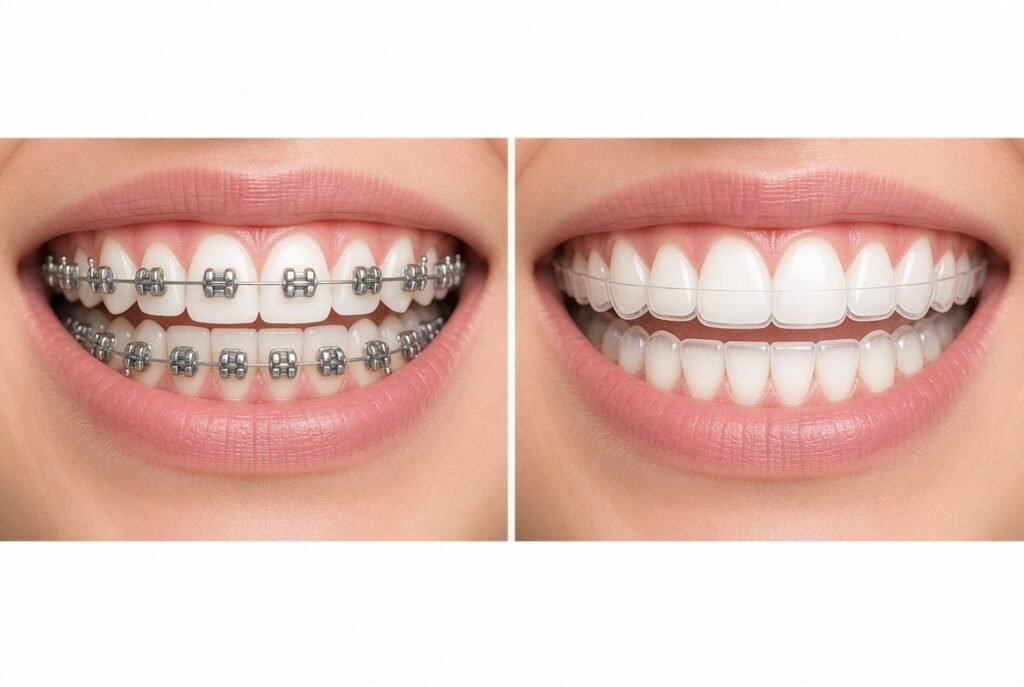
By Dr. Manu Sharma, DMD, board certified orthodontist | October 2026
"Can I just do Invisalign?" is probably the question I hear most often in our Newark office, from teenagers and adults alike. It is a fair question. Clear aligners have changed orthodontics, and for many people they are an excellent choice. For others, braces will get a better, faster, or more predictable result.
The honest answer depends on your bite, your goals, and how you live day to day. This guide walks through what the research actually says about aligners and braces, where each one shines, where each one struggles, and how I help patients decide.
Key Takeaways
- For mild to moderate crowding and spacing, research finds aligners and braces produce similar overall results.
- Braces still have the edge for root control, rotations of rounded teeth, bite closure, and complex jaw problems.
- Aligners only work when worn 20 to 22 hours a day; braces work whether or not you remember them.
- Aligners make brushing and flossing easier, which can help gum health during treatment.
- The best choice comes from a full diagnosis, not from the appliance you prefer before your exam.
How Each System Moves Teeth
Both braces and aligners move teeth the same basic way: a gentle, steady force causes the bone around a tooth root to remodel, and the tooth moves through it. The difference is how that force is delivered.
Braces use brackets bonded to the teeth and an archwire that runs through them. The wire wants to return to its ideal shape, and as it does, it guides the teeth with it. Because the bracket is fixed to the tooth, the orthodontist can control the crown and the root in all three dimensions. You can read more on our braces information page, and if appearance matters, clear ceramic braces offer the same control with tooth colored brackets.
Clear aligners are a series of thin, custom plastic trays. Each tray is shaped slightly differently from the last, and the plastic pushes the teeth toward the next position. Small tooth colored bumps called attachments are often bonded to certain teeth to give the plastic something to grip. Aligners are typically changed every one to two weeks. Our Invisalign page explains the process in detail.
What the Research Says About Results
This is where online marketing and the scientific literature often part ways, so it is worth being precise.
For many cases, overall results are similar. A 2019 systematic review in BMC Oral Health, which pooled data from eight studies, compared aligners and braces using the American Board of Orthodontics Objective Grading System, a standardized way of scoring finished cases. It found no statistically significant difference in overall scores between the two groups, and reported that aligner treatment was on average shorter in the included studies.
But the same review found clear differences in specific areas. Braces performed better at producing solid contacts between the back teeth, controlling torque (the angle of the root), widening the arches, and maintaining results during retention. Aligners did well with segmented movements, meaning moving smaller groups of teeth at a time.
Aligners do not always move teeth as far as planned. A 2020 prospective study in the American Journal of Orthodontics and Dentofacial Orthopedics measured how closely real tooth movement matched the digital plan with Invisalign. Average accuracy across all movements was about 50 percent. Tipping movements were the most accurate, while rotations were the least, with some specific movements, such as rotating the upper canines and intruding the lower incisors, falling below 40 percent. Earlier research in the same journal found that canine rotations and incisor intrusions were the most inaccurate aligner movements.
That does not mean aligners fail half the time. It means the digital plan is a starting point, and good aligner treatment involves planning overcorrections, adding attachments in the right places, and ordering refinement trays when teeth lag behind. The skill of the person planning the case matters a great deal.
Severe cases remain more challenging for aligners. A 2023 systematic review in Cureus that looked specifically at complicated and severe malocclusions found that overall outcome scores were often similar, but that aligners struggled more with anchorage control and with retracting teeth into extraction spaces, where teeth tended to tip rather than move bodily. The authors noted the evidence base was small and called for more research.
Where Clear Aligners Shine
In my experience, and consistent with the research above, aligners are often an excellent fit for:
- Mild to moderate crowding or spacing, especially in adults who want a discreet option.
- Relapse after earlier orthodontic treatment, when teeth have shifted because retainers were not worn.
- Patients with good habits who will reliably wear trays 20 to 22 hours a day.
- People who play wind instruments or contact sports, since there are no brackets against the lips. (A mouthguard is still important for sports.)
- Patients with a history of gum concerns or difficulty cleaning around brackets, because aligners come out for brushing and flossing.
Teens can be great aligner patients too. Our Invisalign Teen page covers the features designed for younger patients, such as compliance indicators.
Where Braces Are Still the Stronger Choice
Braces tend to be more predictable for:
- Significant rotations, especially of rounded teeth like canines and premolars.
- Moving teeth vertically, such as pulling down a tooth that sits too high or closing a deep bite.
- Extraction cases, where large spaces must be closed while keeping roots upright.
- Complex bite problems involving the jaws, such as larger overbites, underbites, and open bites, often combined with growth guidance or expanders in children.
- Patients who are unlikely to wear aligners consistently, which is no criticism, just reality for many busy teens and adults.
It is also worth knowing that the line between the two is blurring. Some patients start with a short phase of braces to handle difficult movements and finish with aligners, or use aligners with additional tools such as elastics.
Comfort, Daily Life, and Hygiene
| Factor | Clear aligners | Braces |
|---|---|---|
| Appearance | Nearly invisible; attachments are small and tooth colored | Visible; ceramic options are less noticeable |
| Eating | Remove trays to eat; brush before putting them back | Eat with braces on; avoid hard, sticky, and chewy foods |
| Wear time | Must be worn 20 to 22 hours daily to work | Always working; no daily decision required |
| Cleaning teeth | Normal brushing and flossing | Requires extra time and tools around brackets |
| Discomfort | Pressure for a day or two with each new tray | Soreness after adjustments; brackets can rub cheeks at first |
| Emergencies | Lost or broken trays | Loose brackets or poking wires |
| Office visits | Often fewer and shorter | Regular adjustment visits, typically every 6 to 8 weeks |
Gum health is a genuine advantage for aligners. Several systematic reviews published in recent years have found that patients wearing clear aligners tend to have less plaque and healthier gums during treatment than patients in fixed braces, mainly because they can brush and floss normally. Braces patients can absolutely keep healthy gums, but it takes more effort. Our guide to brushing and flossing with braces and our list of foods to avoid with braces make that much easier.
The wear time requirement is the biggest practical difference. An aligner in its case is not moving teeth. Most aligner cases that run long or end short of the goal trace back to trays not being worn enough. Be honest with yourself about this before choosing.
What About Cost?
In many practices, including ours, comprehensive aligner treatment and comprehensive braces fall in a broadly similar range, and the final fee depends far more on how complex your case is and how long it will take than on the appliance itself. Dental insurance with orthodontic coverage generally applies to either. If you would like the details, our page on how Invisalign costs and payment plans work explains how fees come together, and our insurance page lists the plans we work with.
Not sure which option fits your smile?
At your free consultation, we take the records needed to see exactly what your bite requires, then show you which options would work and why.
How I Help Patients Decide
The choice should follow the diagnosis, not lead it. At a consultation, we take photographs, a 3D scan, and X rays, including a side profile X ray that shows how the jaws relate. (If you are curious how that image is analyzed, I explain it in our article on cephalometric analysis.) Then I ask three questions:
- What does the bite actually need? If the main problems are movements aligners handle well, aligners are a strong option. If the case depends on root control, large rotations, or jaw correction, braces may be more predictable.
- What matters most to you? Appearance at work, ease of eating, fewer visits, sports, music, and budget all count.
- How will you realistically wear them? A patient who will wear braces well usually gets a better result than one who will wear aligners poorly.
When both options would work well, I say so and let the patient choose. When one would clearly work better, I explain why. That honesty is part of what you should expect from any board certified orthodontist.
A Word About Mail Order Aligners
Direct to consumer aligner companies often skip an in person exam and X rays. Without seeing the roots, the bone, and the gums, problems like gum disease, decay, or a jaw discrepancy can go unnoticed and sometimes worsen. Aligners are a medical device that moves living teeth through bone, and they deserve a proper diagnosis and supervision by a licensed orthodontist.
Frequently Asked Questions
Is Invisalign faster than braces?
Sometimes. A 2019 systematic review found shorter average treatment times with aligners in the studies it included, but those were often milder cases. For complex cases, braces can be just as fast or faster. Wear time is the biggest factor for aligner speed.
Can Invisalign fix an overbite or underbite?
Mild bite problems can often be improved with aligners, sometimes with elastics. Larger overbites and underbites that come from the jaws themselves usually need braces, growth guidance in children, or in some adults a combination of orthodontics and jaw surgery.
Which hurts more, Invisalign or braces?
Both cause pressure and mild soreness, usually for a few days after a new tray or an adjustment. Braces can also rub the cheeks and lips early on, which orthodontic wax helps with. Most patients find either option very manageable.
Are adults too old for braces or Invisalign?
No. Healthy teeth can be moved at any age. Adults now make up a large share of orthodontic patients, and our page on orthodontic treatment for adults covers the options.
Do I need a retainer after Invisalign?
Yes. Retainers are needed after any orthodontic treatment, aligners included, because teeth tend to drift back over time. Our retainers page explains the options.
Find Out Which Option Fits You
There is no single best appliance, only the best appliance for your teeth. If you live in Newark, Fremont, Union City, or Milpitas, we would be glad to take a look and give you a clear, no pressure recommendation.
Your consultation is free
It includes complete diagnostic records, a side by side look at your options, and a written estimate before you decide anything.
This article is general educational information and is not a substitute for an in person evaluation by a licensed orthodontist.
References
- Ke Y, Zhu Y, Zhu M. A comparison of treatment effectiveness between clear aligner and fixed appliance therapies. BMC Oral Health. 2019;19(1):24.
- Haouili N, Kravitz ND, Vaid NR, Ferguson DJ, Makki L. Has Invisalign improved? A prospective follow up study on the efficacy of tooth movement with Invisalign. American Journal of Orthodontics and Dentofacial Orthopedics. 2020.
- Charalampakis O, et al. Accuracy of clear aligners: a retrospective study of patients who needed refinement. AJO DO. 2018;154(1):47 to 54. Summarized in DrBicuspid.
- Jaber ST, Hajeer MY, Sultan K. Treatment effectiveness of clear aligners in correcting complicated and severe malocclusion cases compared to fixed orthodontic appliances: a systematic review. Cureus. 2023;15(4):e38311.
- Comparative impact of clear aligners versus fixed orthodontic appliances on periodontal health, pain, and quality of life: a systematic review and meta-analysis. BDJ Open. 2026.
- Does orthodontic treatment using clear aligners and fixed appliances affect periodontal status differently? Evidence-Based Dentistry. 2023.
- American Association of Orthodontists. How much do braces cost? Financing options for orthodontic treatment. 2025.