
By Dr. Manu Sharma, DMD, board certified orthodontist | October 2026
Cost is one of the first questions families ask, and one of the hardest to answer honestly in a single number. Search online and you will find price ranges so wide they are almost useless, from a few thousand dollars to well over ten thousand. Those numbers are not wrong, exactly. They just leave out the details that decide what your treatment will cost.
This guide explains what actually drives orthodontic fees, how dental insurance treats orthodontics (it works differently than most people expect), how to use pre tax health accounts, what Medi-Cal covers for children in California, and how payment plans make treatment manageable. My goal is that you walk into any consultation, ours or anyone else's, knowing exactly what to ask.
Key Takeaways
- Your fee depends mainly on case complexity and treatment length, not just the type of appliance.
- Orthodontic insurance usually pays a percentage up to a lifetime maximum, often paid out over the course of treatment.
- Braces are an eligible medical expense for HSA and FSA funds under IRS rules; teeth whitening is not.
- Medi-Cal Dental can cover braces for members under 21 who meet medical necessity criteria.
- Always ask whether a quote is all inclusive, covering visits, emergencies, and retainers.
What Actually Determines the Cost of Orthodontic Treatment
The American Association of Orthodontists notes that fees vary from patient to patient and are shaped by the type of treatment, its complexity, and how long it lasts. In practice, these are the factors that move the number most:
- Complexity of the bite. Straightening a few crowded front teeth is a very different project from correcting a deep overbite, an underbite, or a crossbite. Cases that involve the jaws, impacted teeth, or extractions take more time, planning, and appointments.
- Length of treatment. Most comprehensive cases take somewhere between 12 and 30 months. Longer treatment means more visits, more wires or trays, and more chair time.
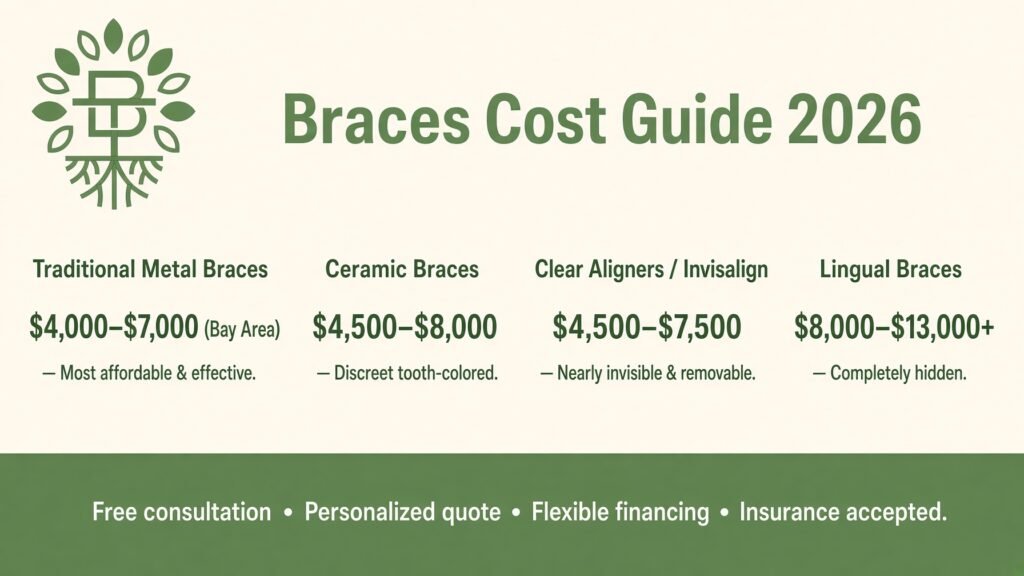
- Type of appliance. The AAO describes traditional metal braces as typically a more affordable option and lingual braces (placed behind the teeth) as usually the most expensive. Clear ceramic braces and Invisalign fall in between in many practices, though complexity often matters more than the appliance itself.
- Phase of treatment. Some children benefit from a short early phase, such as a palatal expander, followed later by a second phase. Others need only one comprehensive phase.
- Additional procedures. Some cases require work outside the orthodontic office, such as extractions by a general dentist or oral surgeon, or jaw surgery for certain adults. Those fees are usually billed separately.
- What is included. Some quotes cover everything from the first bracket to the final retainer. Others itemize records, emergency visits, or retainers separately. That difference alone can explain a large gap between two quotes.
If you are comparing practices, make sure you are comparing the same thing. A lower headline price that excludes retainers or broken bracket visits may end up costing more.
Why You Should Be Wary of a Single Online Price
Online cost calculators and averages blend together children and adults, mild and severe cases, and very different regions. The Bay Area also has higher operating costs than many parts of the country, which affects fees at every practice here. An average from a national website tells you little about your own case. A consultation with diagnostic records, which at our office is free, gives you a real figure for your teeth, in writing, before you commit.
How Orthodontic Insurance Really Works
Orthodontic coverage is usually a separate benefit within a dental plan, and it follows its own rules. The AAO suggests asking your insurer about the covered percentage, the lifetime maximum, age limits, and whether your orthodontist needs to be in network. Here is what those terms mean in practice:
| Term | What it means for you |
|---|---|
| Coverage percentage | Many plans pay a set percentage of the orthodontic fee, or a fixed benefit amount, up to the plan's limit. |
| Lifetime maximum | The most the plan will ever pay toward orthodontics for that person. Once it is used, it does not reset each year. |
| Age limit | Many plans cover orthodontics only for dependents under a certain age. Adult coverage exists but is less common. |
| Payment schedule | Insurers frequently pay the benefit in installments over the treatment period rather than all at once. |
| Waiting period | Some plans require you to be enrolled for a period before orthodontic benefits begin. |
| In network | An in network orthodontist has agreed to the plan's negotiated fee, which can lower your total cost. |
A few practical tips:
- Check before you start. If coverage changes partway through treatment, for example due to a job change, the remaining benefit may or may not continue. Ask your insurer how they handle treatment already in progress.
- Look at both parents' plans. If your child is covered under two dental plans, coordination of benefits may allow both to contribute toward orthodontics.
- Open enrollment matters. If you know treatment is coming, it may be worth choosing a plan with orthodontic coverage during your employer's next enrollment period.
Our team verifies your specific plan and builds the benefit into your written estimate. You can see the carriers we work with on our insurance page.
Using HSA and FSA Funds for Braces
Health savings accounts (HSAs) and flexible spending accounts (FSAs) let you pay for qualified medical and dental expenses with pre tax dollars, which effectively lowers the cost of treatment by your tax rate.
Braces qualify. IRS Publication 502 lists braces among the dental procedures that count as medical expenses, alongside X rays and fillings. It specifically excludes cosmetic procedures such as teeth whitening, but orthodontic treatment to correct a bite or alignment problem is treated as dental care.
Know your limits. For plan years beginning in 2026, the IRS caps employee salary reduction contributions to a health FSA at $3,400. HSA limits are separate and depend on whether you have self only or family coverage. The AAO also reminds families that many FSAs follow a "use it or lose it" rule within the plan year, so timing matters.
Some strategies families use:
- Front load an FSA. Because the full annual FSA election is often available early in the plan year, some families time the start of treatment or a down payment to make full use of it.
- Split across plan years. Treatment that spans two plan years may let you use two years of FSA contributions.
- Keep records. Save itemized statements from the orthodontic office for your account administrator.
The medical expense deduction. If you itemize deductions, the IRS allows you to deduct qualifying medical and dental expenses only to the extent they exceed 7.5 percent of your adjusted gross income. For most families that threshold is high, but it can matter in a year with large medical bills.
Tax rules have details and exceptions, so please confirm your situation with your tax professional or benefits administrator. I am an orthodontist, not a tax advisor.
Medi-Cal and Braces for Children in California
Medi-Cal Dental can cover orthodontic treatment for members under 21 when the bite problem meets medical necessity criteria. Under California's longstanding rules, this generally means a score of at least 26 on the Handicapping Labio-Lingual Deviation (HLD) index, a standardized measure of bite severity, or one of several automatically qualifying conditions. Those conditions include cleft palate deformities, a deep overbite in which the lower teeth damage the roof of the mouth, front tooth crossbites that are destroying gum tissue, very large overjets with lips that cannot close, and severe traumatic deformities. Mild crowding typically does not qualify.
Coverage requires a provider who participates in Medi-Cal Dental and prior authorization, and criteria can change, so check current requirements with the program or a participating orthodontist.
The AAO also points families toward charitable programs, such as Smiles Change Lives and Smile for a Lifetime, that provide reduced cost or free treatment for qualifying children.
Want a real number for your case?
Your free consultation includes diagnostic records and a written estimate with your insurance benefit already applied.
Payment Plans and Ways to Make Treatment Affordable
The AAO notes that many orthodontic practices offer in house payment plans spread over months or years, often with low or no interest. At our office, we offer 0 percent payment plans, and our financial policy page explains how they work. Other ways families reduce the overall cost include:
- Asking about pay in full discounts if paying upfront is possible.
- Asking about family discounts when siblings or a parent and child start treatment around the same time.
- Following care instructions closely. Broken brackets, lost aligners, and missed retainer wear can add replacement costs and extra time.
- Treating at the right time. Starting a child too early can add months and cost without adding benefit. Starting at the right time, guided by an early orthodontic evaluation, can make treatment shorter and simpler.
The Real Cost of Choosing on Price Alone
Orthodontics is an investment in teeth you will keep for the rest of your life. A plan built without proper records, or treatment supervised loosely, can mean redoing work later, which is the most expensive outcome of all. When comparing options, weigh the training of the provider, the completeness of the diagnosis, what is included in the fee, and how retention is handled afterward. Our article on how to choose an orthodontist covers the questions worth asking.
Questions to Ask at Any Consultation
- What exactly does this fee include? Records, visits, emergency repairs, and retainers?
- How long do you expect treatment to take, and what could make it longer?
- How will my insurance be applied, and when does the insurer pay?
- Is there a down payment, and what are the monthly terms?
- What happens if treatment runs longer than planned? Are there extra charges?
- What do replacement retainers cost after treatment ends?
Frequently Asked Questions
Is Invisalign more expensive than braces?
Not necessarily. In many practices the fees overlap, and the complexity and length of treatment affect cost more than the appliance. Our page on Invisalign cost explains how those fees come together.
Does dental insurance cover braces for adults?
Some plans do, but many limit orthodontic coverage to dependents under a certain age. Check the age limit and lifetime maximum on your plan, or let our team verify it for you.
Can I use my HSA or FSA for braces or Invisalign?
Generally yes. IRS Publication 502 lists braces as a qualifying dental expense. Confirm the details with your plan administrator, and keep itemized statements.
Does Medi-Cal pay for braces?
For members under 21 whose bite meets medical necessity criteria, such as an HLD index score of 26 or higher or certain qualifying conditions, Medi-Cal Dental can cover orthodontic treatment through a participating provider.
Is the consultation really free?
Yes. At our office, the exam, diagnostic records, and written estimate are complimentary, with no obligation to start treatment. Our first visit page explains what to expect.
Get a Clear, Written Estimate
Families from Newark, Fremont, Union City, and Milpitas deserve a straight answer about cost before making a decision. We will check your benefits ahead of time if you call, so your estimate is ready when you arrive.
Know your number before you decide
Call or text us and we will verify your insurance in advance at no charge.
This article is general educational information and is not a substitute for an in person evaluation by a licensed orthodontist.
References
- American Association of Orthodontists. How much do braces cost? Financing options for orthodontic treatment. 2025, updated 2026.
- Internal Revenue Service. Publication 502: Medical and Dental Expenses. For use in preparing 2025 returns.
- Internal Revenue Service. Publication 15-B (2026): Employer's Tax Guide to Fringe Benefits. Health FSA contribution limit.
- California Department of Social Services, State Hearings Division. Medi-Cal orthodontic services: handicapping malocclusion criteria.
- California Department of Health Care Services. EPSDT services, Medi-Cal Dental.