
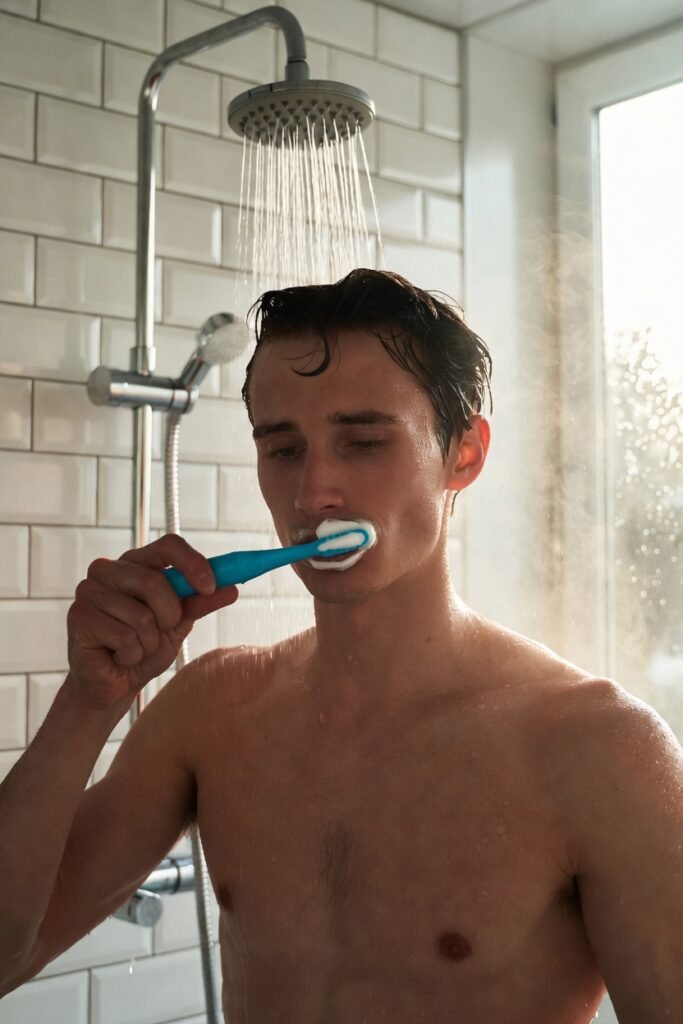
Someone asked me today, is okay to brush while I shower. I really have crunch in the morning time and it got me thinking.
The short answer: Brushing in the shower isn’t dangerous, but it introduces enough friction points that it tends to make people brush worse, not better. For most patients, the sink is the better default, not because the shower is inherently harmful, but because it removes variables that matter.
The hygiene concern is real but often overstated
The bacteria argument gets a lot of airtimes, but it’s worth calibrating. Yes, a perpetually damp shower environment promotes microbial growth, and the ADA does advise against storing your toothbrush in the shower between uses. But the risk isn’t dramatic for a healthy adult with a functioning immune system, it’s more of a low-grade, chronic hygiene downgrade than an acute threat. The more legitimate concern is mold and soap scum contact if the shower isn’t cleaned regularly. If someone is storing their brush on a shower shelf next to a mildew-prone grout line, that’s a genuine problem. The fix is simple, bring the brush in, take it out, but most people won’t do that consistently.
The technique problem is the real issue
This is where I’d focus if I were counseling a patient. Effective brushing requires:
- Consistent 45-degree angulation at the gumline
- Systematic coverage of all surfaces (buccal, lingual, occlusal)
- Two full minutes of actual brushing time
- Enough attention to feel what you’re doing
The shower works against all of these. You’re multitasking, rinsing off, managing water temperature, thinking about your day. You don’t have a mirror to catch the areas you’re skipping. The noise and sensory environment pull your attention. Most people who brush in the shower are doing it on autopilot, and autopilot brushing reliably misses the lingual surfaces of lower anteriors and the distal of second molars, the same spots that show up as problems at recall appointments.
Two minutes also gets compressed. Without a timer or a mirror cue, people shorten it. That matters more than most patients realize — research consistently shows that brush time correlates with plaque removal, and the difference between 60 seconds and 120 seconds is clinically meaningful.
Flossing essentially disappears
This is the consequence that I think gets underweighted in most discussions. When you brush at the sink, flossing is a natural extension of the routine, you’re already there, the floss is in the drawer, you have a mirror. When you brush in the shower, there’s no natural flossing trigger. You get out, you towel off, you move on. Interproximal surfaces are where the majority of carious lesions and early periodontal attachment loss begin, and they are entirely missed by brushing alone. Any habit that makes flossing less likely is a net negative for long-term oral health, full stop.
Water savings is mostly a wash
“But hey, I save water when I brush and shower together, don’t I?”. Proponents often cite environmental efficiency. The math doesn’t hold up well. A standard showerhead runs 2 to 2.5 gallons per minute. Brushing at the sink with the faucet off uses effectively zero. Even with a low-flow showerhead, if brushing extends your shower by two minutes, you’ve used more water than you would have at the sink. The only scenario where it truly saves water is if you’re multitasking precisely, brushing while the conditioner sets, not extending shower time at all, and you would have left the sink faucet running otherwise. That’s a narrow set of conditions. Who it might actually work for I don’t want to be absolutist about this. There’s a subset of patients for whom shower brushing is the only realistic path to brushing twice a day, shift workers with chaotic routines, people who genuinely forget if it’s not embedded in the shower ritual, people with sensory preferences that make sink brushing aversive. For those patients, twice-a-day shower brushing with a dry-stored brush beats once-a-day sink brushing. Compliance is foundational. If someone is going to brush once either way, I’d rather they do it in whatever context they’ll actually execute it. But for most people, the default recommendation should be the sink: you have a mirror, you have proximity to floss, you have a less distracting environment, and you can more easily time yourself. Bottom Line: The framing I’d suggest: this isn’t a binary “gross vs. fine” question. The shower isn’t going to give you cavities, but it quietly erodes the conditions that make brushing effective. The ADA’s position – “we don’t prohibit it, just don’t leave the brush in there” – is technically accurate but undersells the behavioral risk. The more honest clinical message is: brush wherever you’ll do it right, and most people do it right at the sink.