
Early Orthodontic Evaluation: When Should Your Child First See an Orthodontist?
Most parents picture braces as a middle school milestone. By then the teeth are crooked enough that even a passing glance confirms what everyone already knows. What gets missed is everything that happens earlier, when an orthodontist can still see how the jaws are growing, how the permanent teeth are coming in, and whether anything is quietly developing in the wrong direction.
That is why the American Association of Orthodontists recommends that every child have their first orthodontic evaluation by age 7. Not to start treatment in most cases. Just to look.
At BirchTree Orthodontics in Newark, board-certified orthodontist Dr. Manu Sharma sees children from across Newark, Fremont, and Union City for these first evaluations. This page explains what the visit involves, why age 7 specifically, what we are looking for, and what happens afterward. The short version: most kids who come in at this age do not need treatment. They need a baseline.
The bottom line. Even if your child sees the dentist regularly, an orthodontic evaluation is a different exam looking for different things. The AAO recommends scheduling the first visit by age 7, and you do not need a referral.
Why age 7? The science behind the recommendation
Around age 7, most children have a mix of baby teeth and permanent teeth. The first permanent molars and the upper and lower front teeth have usually erupted. That mix gives an orthodontist enough information to evaluate how the jaws and the permanent dentition are developing, while the bones are still growing and responsive to guidance.
The recommendation is grounded in decades of clinical research. A 2025 systematic review in Children on the timing of orthodontic intervention found that, in selected cases, early intervention significantly improves skeletal development, arch dimensions, and airway space when compared to waiting for full adolescence.1 A separate Cochrane review on Class II malocclusion (prominent upper front teeth) found that early treatment reduced the risk of trauma to the front teeth, a meaningful finding given that children with overjet greater than 5 mm carry roughly double the risk of incisor injury.2
The point is not that every 7 year old needs braces. The point is that some orthodontic problems are easier to correct, or easier to prevent from getting worse, while a child is still growing. By the time all the permanent teeth are in, the window has narrowed for the conditions where growth modification matters most.
Schedule your child's first orthodontic evaluation
Free, no obligation, and no referral needed. We see kids from Newark, Fremont, Union City, and the rest of the Tri City area.
Why a board-certified orthodontist for the first visit
You can ask your general or pediatric dentist to do a developmental check at a regular cleaning and many do. An orthodontic evaluation is a different exam. Orthodontists complete two to three additional years of full time residency in dentofacial orthopedics, which is the discipline that studies how teeth, jaws, and the face grow and interact. Dr. Manu Sharma is board-certified by the American Board of Orthodontics, the highest credential in the specialty, and brings nearly a decade of general dental practice before her orthodontic residency. That background helps her see the whole picture, not just the teeth.
What an early orthodontic evaluation actually involves
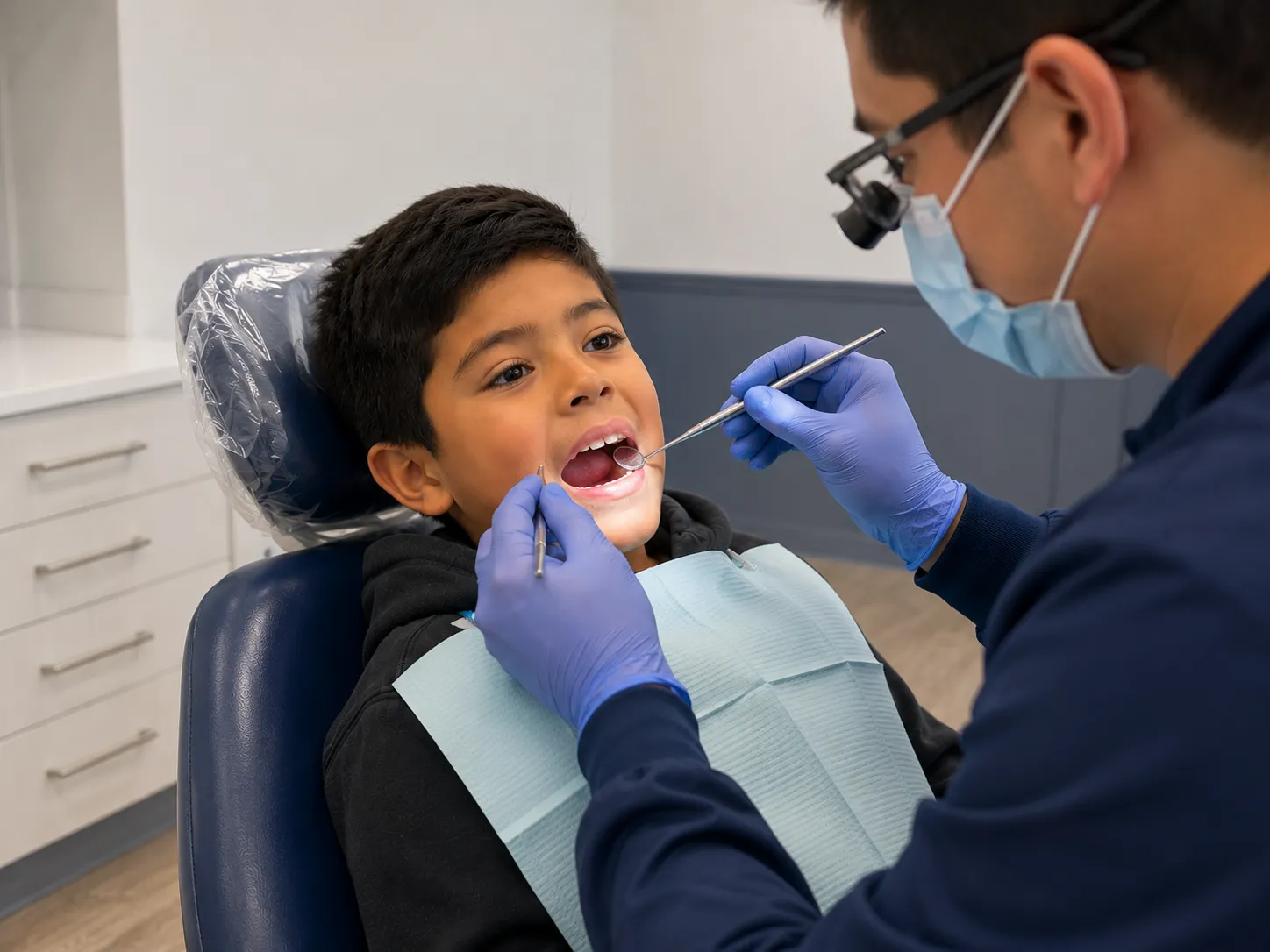
The first visit at BirchTree is calm, conversational, and free. There are no shots, no drilling, and no commitment to treatment. The goal is to gather information and answer your questions.
The clinical exam
Dr. Sharma examines the way the upper and lower teeth come together, the spacing and crowding pattern in both arches, the width of the upper jaw, the position of any erupting permanent teeth, and the symmetry of the face and bite. She also looks for habits that can shape the developing bite, such as thumb sucking, prolonged pacifier use, mouth breathing, or tongue thrusting.
Imaging when indicated
Some children benefit from a panoramic X-ray to see teeth that have not yet erupted, including any that may be missing, extra, or developing in the wrong position. Not every first visit requires imaging. When it is appropriate, we use low-dose digital systems and explain why before we proceed.
The conversation
After the exam, Dr. Sharma sits down with you and your child to explain what she sees. She uses plain language, shows you intraoral photos when helpful, and tells you honestly which of three categories applies:
- No orthodontic concerns at this time. Check in again in 6 to 12 months.
- Something is developing that we want to monitor. Recall every 6 months until the right window opens.
- Something is happening now that benefits from early orthodontic treatment, and here is what that would involve.
Most children fall in the first or second category at age 7. The minority who fall in the third category are exactly the children for whom the AAO recommendation matters most.
What we are watching for
An early evaluation is screening for specific conditions that respond better to early intervention than to waiting. The most common ones we look for include:
Posterior crossbite
The upper back teeth are supposed to sit slightly outside the lower back teeth when the jaws come together. When the opposite happens on one or both sides, the lower jaw often shifts to one side to find a comfortable bite. Left uncorrected, that shift can lead to asymmetric jaw growth. A palatal expander in early mixed dentition resolves this in months, while waiting until adolescence makes correction harder and sometimes requires surgery.
Severe crowding or arch length problems
If the dental arch is too narrow to fit the permanent teeth that are still coming in, planning early gives more options. Sometimes mild expansion is enough. Sometimes we monitor and intervene later. The earlier we know, the more options we keep open.
Skeletal Class III tendency
When the lower jaw is growing further forward than the upper jaw (often visible as an underbite), early treatment with a facemask or other maxillary protraction can change the trajectory of growth in ways that adolescent treatment cannot.3 This is one of the conditions where age 7 to 9 is genuinely the right time to act.
Severe overjet (protruding front teeth)
Children with significantly protruded upper front teeth are at meaningfully higher risk of dental trauma from a fall, a sports collision, or a playground bump. Early treatment can reduce that risk and improve self esteem in a child who is becoming aware of their smile.
Habits affecting the developing bite
Persistent thumb sucking past age 5 to 6, tongue thrusting, and chronic mouth breathing can shape the palate, the tongue posture, and the bite. Identifying these early opens the door to gentle habit appliances or referrals to ENT or speech specialists when appropriate.
Impacted or missing permanent teeth
A panoramic X-ray sometimes reveals a permanent tooth that is forming in the wrong position, blocked by another tooth, or congenitally missing. Early awareness gives the family time to plan and prevents avoidable complications later.
Phase 1 treatment, when it makes sense
For the smaller group of children whose evaluation shows a problem that benefits from early intervention, treatment in this age range is called Phase 1, or interceptive orthodontics. Phase 1 is short, usually 9 to 18 months, and uses targeted appliances to address the specific issue, not full braces on every tooth. After Phase 1, most children rest in a retention or observation period until the remaining permanent teeth come in, at which point a Phase 2 treatment with braces or aligners may follow.
If your child’s evaluation falls in this category, Dr. Sharma will walk you through the recommended appliance (often a palatal expander, partial braces, or a habit appliance), the timeline, the cost, and what to expect. You can read more on the early orthodontic treatmentpage or ask us at the visit.
Most kids do not need treatment at age 7. That is not a bad outcome.
One of the most common misconceptions about early orthodontic evaluation is that it always ends in braces, expanders, or some other appliance for a 7 year old. It usually does not. In a healthy mixed dentition with no concerning patterns, the right answer is to check in every 6 to 12 months and revisit the question as more permanent teeth come in.
What you get from the first visit, even when no treatment is recommended, is a baseline and a relationship. We know what your child’s bite looked like when the first permanent molars came in. We can compare against that as growth continues. If something does emerge later, we can act at the right moment instead of finding it after the window has closed.
Why a board-certified orthodontist for the first visit
You can ask your general or pediatric dentist to do a developmental check at a regular cleaning, and many do. An orthodontic evaluation is a different exam. Orthodontists complete two to three additional years of full time residency in dentofacial orthopedics, which is the discipline that studies how teeth, jaws, and the face grow and interact. Dr. Manu Sharma is board-certified by the American Board of Orthodontics, the highest credential in the specialty, and brings nearly a decade of general dental practice before her orthodontic residency. That background helps her see the whole picture, not just the teeth.
Schedule your child's first orthodontic evaluation
Free, no obligation, and no referral needed. We see kids from Newark, Fremont, Union City, and the rest of the Tri City area.
Frequently Asked Questions
My dentist hasn't recommended an orthodontist. Should I still come?
- Yes. The AAO recommendation is for every child to be seen by age 7 regardless of whether a dentist has referred. Dentists and orthodontists look for different things. You also do not need a referral to schedule an orthodontic evaluation.
Does an early evaluation mean my child will need braces sooner?
- Not necessarily. Most children seen at age 7 do not need treatment yet. The point of the visit is to identify the small number of cases where early action genuinely changes outcomes and to establish a baseline for everyone else.
How much does the first visit cost?
The first orthodontic evaluation at BirchTree is complimentary. There is no charge for the exam or the consultation conversation. If imaging is needed and not already on file, we will discuss it with you before proceeding.
What if we wait until my child is older?
- For most children, waiting is fine. For a meaningful minority, waiting means the window for the most effective treatment has closed. Skeletal Class III patterns, crossbites that are shifting the jaw, and severe overjet associated with trauma risk are conditions where age 7 to 9 is genuinely the right time. Without an evaluation, you cannot tell which category your child is in.
Will my child need X-rays at the first visit?
- Sometimes. A panoramic image can show developing teeth that are not yet visible in the mouth. We only take imaging when there is a clinical reason and use modern low-dose digital systems. Many children do not need imaging at the first visit.
How long does the first visit take?
- Plan for about 45 to 60 minutes. That includes paperwork, the exam, any imaging if needed, and the conversation afterward to walk you through what we found and what we recommend.
Where is BirchTree Orthodontics located?
- We are at 3900 Newpark Mall Road, Suite 204, Newark, CA 94560, just off the 880 freeway near Newpark Mall. Easy access for families coming from Fremont, Newark, and Union City.
References
Dinu S, Igna A, Petrescu EL, et al. Timing of Orthodontic Intervention for Pediatric Class II Malocclusion: A Systematic Review on Early vs. Late Treatment Outcomes. Children (Basel). 2025;12(11):1533. PMC12651552
Batista KB, Thiruvenkatachari B, Harrison JE, O’Brien KD. Orthodontic treatment for prominent upper front teeth (Class II malocclusion) in children and adolescents. Cochrane Database of Systematic Reviews. 2018;(3):CD003452. doi.org/10.1002/14651858.CD003452.pub4
Evidence-Based Approaches in Clinical Orthodontics: A Narrative Review. Healthcare. 2025. PMC12487724
American Association of Orthodontists. The Milestone Visit: Why Age 7 is the Best Age for Orthodontic Treatment. aaoinfo.org